Technology designed to outsmart feral cats
With partners, we’re developing AI-powered technology to help the fight against feral cats.
Aboriginal and Torres Strait Islander people should be aware that this site may contain images, voices and names of people who have passed away.


Bush Heritage Australia is supporting research into whether environmental DNA (eDNA) preserved in sediment and bones can reveal which animals lived in parts of Australia before European colonisation. This information could guide habitat restoration, threat management and potentially encourage locally extinct species back to the landscape.
Experimental eDNA research on our reserves is helping unearth the past and shape the future.
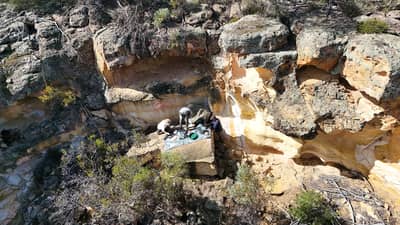
Caves, crevices and outcrops. For Luke Jackman, the thrill of the hunt is matched only by a perfect find. “It’s awesome,” says Luke, “because you know it will probably yield really good data.”
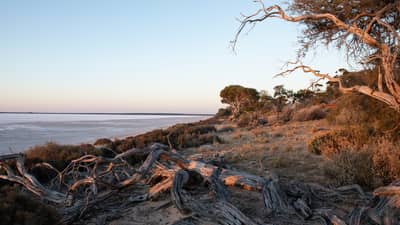
The Adelaide University PhD student’s voice brightens as he describes searching for rocky shelters at three of our reserves in Western Australia; Ediegarrup and Monjebup on Goreng Noongar Country, 140 km north-east of Albany; and Charles Darwin Reserve on Badimia Country, 220 km south-east of Geraldton.
The field trips were part of a research project that is digging into the past to help the future of conservation on this continent.
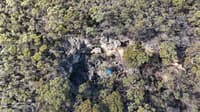
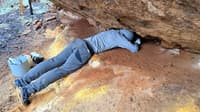
“We’re looking for signs of animal presence, so scats, bones and prints,” explains Luke. “Then what we want to see, in a perfect scenario, is something deep you could crawl into with a lot of organic material in the sediment. We prefer a clayey kind of sediment. We want no plants and no signs of water. We also want the shelter to ideally face away from the dominant source of weather.”
Why this checklist? Because that’s where Luke’s most likely to discover the deoxyribonucleic acid (DNA) remains of animals, some of which may have been locally extinct for many years.
Luke’s PhD is focused on how microscopic traces of environmental DNA (eDNA) – left, for example, from hair, bone and skin cells, and preserved over decades or perhaps, even centuries – could reveal the pre-colonisation distribution of some of Australia’s rarest animals.

While eDNA techniques are more commonly used with water samples, Luke and the project team are experimenting with applying this type of analysis to sediment and bone samples.
The team believes these tiny clues, when added to existing knowledge from early European naturalist accounts, Traditional Custodians and fossil records, can guide the protection and restoration of precious habitats to encourage locally extinct species to return to their former ranges.
Considering Australia has the worst record of recent mammal extinctions in the world, there’s a lot riding on this work.
But to get the data, you’ve got to dig.
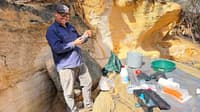
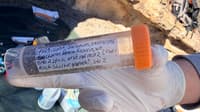
“We set up our equipment, and we sterilise everything with bleach and isopropyl alcohol,” explains Luke. “And we start sampling the sediment in 5 cm or 10 cm levels and recording what we find. We record the colour and texture of the sediment. If we find any scat buried in a level, we’ll mark that and then put it in a tube. Between each level, we’ll sterilise our tools again.”
– Luke Jackman, Adelaide University PhD student“We basically do the entire excavation, then get the tube and stick it into the side of the exposed profile of the dirt wall. And that’s our sample.”
Luke’s supervisor, Professor Damien Fordham from Adelaide University’s Environment Institute, says Luke’s samples from our Ediegarrup, Monjebup and Charles Darwin reserves are now being analysed alongside samples previously collected by the Bush Heritage team at Boolcoomatta Reserve on Adnyamathanha and Wilyakali Country in South Australia, and others from across Australia.
“We extract the DNA, we amplify that DNA and then we send it off for sequencing,” explains Damien. “It comes back to us, and then we do the meta-barcoding and bioinformatics [a method of quickly identifying multiple species at the same time].
“Bioinformatics is used to match sequences to large databases of genetic information, enabling us to identify the species in the DNA samples.”
“The hope is that we’ll be able to detect species no longer found in these areas and reconstruct the past communities of mammals and habitats they lived in at the time of European arrival. That should open up greater chances for conservation.”
Bush Heritage’s Chief Scientist, Associate Professor Hedley Grantham, says Goreng Noongar and Badimia Traditional Custodians were consulted before the fieldwork began in Western Australia to ensure it was culturally appropriate and that we will continue to engage with them throughout the project.
Hedley explains that collaboration on the eDNA project complements Bush Heritage’s existing expertise in landscape restoration and the adaptive management of introduced predators and other threats.
“A key focus of ours is using this information to better identify and manage threats to the landscapes we protect; because even if we encourage those species to our reserves you’ve still got to make sure the problem that made them extinct in the first place is dealt with,” explains Hedley, adding that the project could guide our future landscape management.
“We’ve adopted a lot of cutting-edge tools so that when we buy a reserve, we’re buying the most strategic piece of land,” says Hedley. “We want to bring back threatened species, but we also want to think about how ecosystems function.”
Damien says the current and projected future impacts of climate change, including warming temperatures and increasingly extreme weather, are being factored into the research.
“We will be able to develop spatially explicit models of where it would be best to be releasing different species, taking into account what the climate is today and what the climate could be in the future,” explains Damien. “The end game here is to have a systematic conservation planning tool for organisations such as Bush Heritage.”
“At the moment we’re focused on mammals and plants [but] we’re already starting to talk to our partners about how we can take this to the next level and apply these same techniques to amphibians, birds and reptiles. It’s extraordinarily exciting.”
Technology, innovation and the future of conservation: all in a day’s work for Bush Heritage, our partners, and these DNA detectives. •
We gratefully acknowledge Adelaide University, Australian Wildlife Conservancy, World Wide Fund For Nature Australia and the Invasive Species Council for their contributions to this collaborative project.