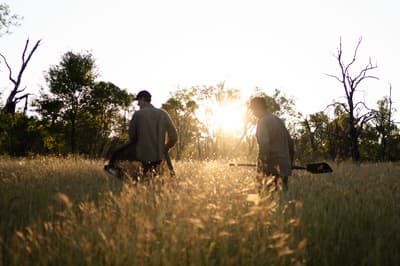
Technology designed to outsmart feral cats
With partners, we’re developing AI-powered technology to help the fight against feral cats.
Aboriginal and Torres Strait Islander people should be aware that this site may contain images, voices and names of people who have passed away.
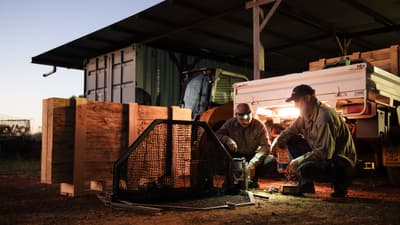
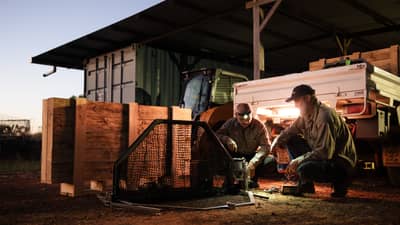
Bush Heritage Australia, with partners eVorta and Timberscope, are developing and testing AI-enabled cameras and traps to detect feral cats and improve the efficiency and precision of feral cat control.
With partners, we're developing AI-powered technology to help the fight against feral cats.

– Dr James Smith, Bush Heritage ecologist“Research shows feral cats kill approximately 2 billion native animals every year, and were a primary or contributing factor in 26 of 33 mammal extinctions.”(1)
These are dire statistics, but Bush Heritage is working to reduce these numbers by leading a partnership, which utilises AI-powered technology.
Joining the partnership are First Nations ethical trapping business Timberscope and AI technology provider eVorta.
“Feral cats are the perfect hunters,” Rod Brindley, co-founder of Timberscope, says as he watches a trapped cat on his phone. “They’re highly intelligent, they don’t need to drink because they can get hydration from their prey, they can live anywhere in Australia, and they have up to three litters a year.”
Controlling cats at a landscape level has always been fraught.
“Cats are hard to monitor and can be hard to catch,” James, who has worked across Australia’s varied landscapes for 30 years, says. “In many places, cats are not seen until nocturnal surveys show how many are out there and the impacts they’re having.”
Cat control has been hampered by scale, cost and technological stagnation. Checking cameras and traps on a regular basis requires huge amounts of labour and travel. Cameras have limited monitoring capability.
But help, and hope, is at hand. Funded under the Australian Government’s Saving Native Species program, and guided by the Threatened Species Action Plan 2022–23, a $1.7 million ’Game Changers’ grant was awarded to the partnership with the aim of bringing to market new technology for controlling feral cats.
The keystone development is the eVorta Series cameras, which represent a giant leap over traditional passive infrared-triggered (PIR) cameras.
These utilise thermal triggering, user-defined detection zones and multi-sensor imaging, which is then connected to 4/5G and low-Earth-orbit satellites.
But the key differences are the high-resolution imagery and the ability to process images essentially in real-time in the field.(2)
“Imagine it as a platform that sucks data in and then goes through images and labels the species it finds,” says Hamesh Shah from eVorta. “You can capture thousands of images in a day, and it can label them all with a high rate of accuracy.”
An eVorta camera will first be deployed in two new devices. One is an ultrasonic deterrent aimed at exploiting the cats’ sensitivity to high-frequency sound, and other animals’ inability to hear it.
It is hoped that it will be used in situations such as sensitive bird-nesting sites. Twenty of these devices are being rolled out Australia-wide.
The second uses the eVorta camera coupled with a Humane Animal Net Device (HAND) trap developed by Timberscope.
In a micro-second, the technology can identify a cat, deploy a soft net to capture the animal unharmed and quickly notify the land manager. The speed of the technology allows for faster and therefore more humane control decisions to be made in the field.
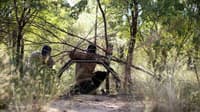
“Traditionally, leg-hold traps have been effective with cats, but their drawback was catching non-target species,” Rod says. “With the eVorta cameras and HAND traps you can choose what species you want to catch, in this case cats.”
“The trap can be put in hard-to-access places, can be triggered automatically and will save us more time compared to manually checking traps.”
The partnership rolled out a test version of the AI-enabled trap on Bush Heritage’s Naree Reserve, Budjiti Country, 130 km north-west of Bourke, northern New South Wales. In June 2025, the first cat was caught.
For Hamesh it was a pivotal moment. “I’m always thinking about the tenuous links in this weird, elaborate machine and to have it actually work was exhilarating. It gave us the impetus to push on and refine the model.”
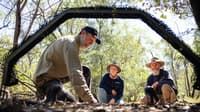
Now 100 units are being deployed around the country across differing habitats.
“In desert regions we’re working with a lot of sand in very remote areas. On Christmas Island we have red crabs wanting to pick things apart,” James says of the varied challenges.
“We’re not creating a prototype that’s going to sit in a lab,” Hamesh adds.
– Hamesh Shah, eVorta"“I’m a technologist providing a tool, but you want the rigour and science of an organisation like Bush Heritage to define how the tool is used.”
Hamesh sees the eVorta cameras and software complementing existing conservation programs.
“It could be used to detect avian flu in seals on a beach, or it could harmlessly capture a bandicoot that needs to be tagged,” he says.
“I’m a technologist providing a tool, but you want the rigour and science of an organisation like Bush Heritage to define how the tool is used.”
The eVorta AI platform is already well validated. A 2024 peer-reviewed study demonstrated significant reductions in cost, staff time and carbon emissions compared to traditional methods.(2)
By the end of the ’Game Changers’ program, the new devices will have been field-tested across five states in a multitude of environments.
But James sees beyond the world of data.
“These new devices are intended to add another set of tools to our conservation toolkit, helping us tackle the challenges of managing invasive species and improve efficiency across the sector.
This new technology may not be the complete solution to end cat-caused extinctions, but it has the potential to drastically reduce the impact cats have on our native animals.” •
This project received grant funding from the Australian Government’s Saving Native Species program and is made possible through our collaboration with project partners eVorta and Timberscope.